Infrastructure
MpatiQ
Trust infrastructure for building, preserving, and transporting contextual records of lived work and responsibility across jobs, communities, and platforms.
Deployment Surface
MpatiQ
Operational State
Classification
TRUST INFRASTRUCTURE
Code Access
PRIVATE PROPRIETARY
Core Thesis
Much of human trust is experienced, witnessed, and remembered, yet rarely preserved in structures that people can carry forward, across communities, opportunities, and systems.
A caregiver may become deeply trusted by families and remain invisible outside those relationships. A tradesperson may spend years earning confidence through consistency, skill, and care, only to begin again whenever context changes.
MpatiQ provides a way for contextual records of lived work and responsibility to become portable without reducing people to scores, rankings, follower counts, or engagement metrics.
System Principles
Trust is infrastructure.
Structure without reduction.
Ownership before validation.
Context over compression.
Continuity over performance.
History should be preserved, not optimized.
Architectural Notes
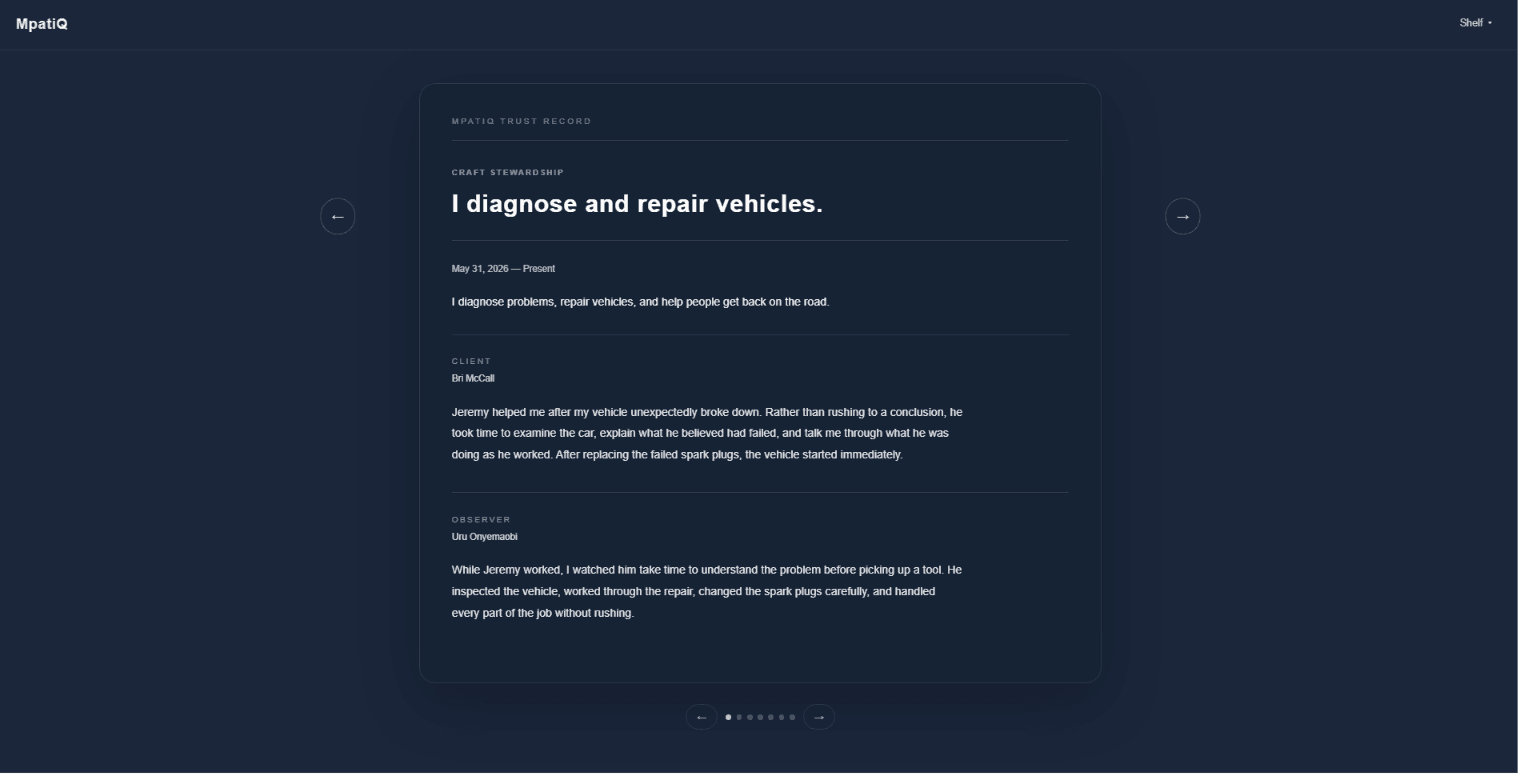
Claims and Trust Records
How claims form the foundational units of a person-owned contextual record.
Trust Window Architecture
How lived work and responsibility are preserved across ongoing and completed windows.
Artifact Architecture
How evidence is anchored to the periods of work in which it belongs.
Constitutional Trust State Machine
The governing trust-state transitions underlying MpatiQ.
Trust Portability Across Contexts
How records can travel beyond the systems and environments in which they were created.
Witness Reflection Architecture
How firsthand witnesses can add context to periods of lived responsibility.
Disciplines
Systems Design
Trust Architecture
Naming & Ontology Design
Domain-Driven Design
Writing
Research & Analysis
Data Modeling
Product Engineering
Full Stack Development
Tooling
Foundation
TypeScript
React
Next.js
Interface
Tailwind CSS
Data & Persistence
Prisma
Supabase
Communication
Resend
Deployment
Vercel
Quality Assurance
Jest