Research
AshaGuard
An early research prototype exploring trust-sensitive care systems through reflective interaction and behavioral observation, examining how future AI systems might help caregivers notice subtle behavioral and trust drift over time.
Historical Context
Built in 2025, AshaGuard represents an early research exploration into trust-sensitive care systems. Developed within MpatiQ Labs, the prototype examined whether reflective writing and future AI-assisted interpretation could help caregivers notice subtle behavioral and trust drift in people living with Alzheimer's disease. While the implementation remained intentionally simple, the artifact preserves the original research question and interaction model that motivated the work.
Core Thesis
AshaGuard began with a core question: could structured reflection and future AI systems help caregivers notice subtle behavioral and trust drift that often emerges gradually over time?
Rather than attempting diagnosis or clinical decision-making, the prototype explored how reflective interaction might become an additional source of context for supporting care, preserving observations, and surfacing patterns that may otherwise go unnoticed.
System Principles
Support care, not replace judgment.
Surface patterns before conclusions.
Treat reflection as meaningful context.
Architectural Notes
Reflective Input Surface
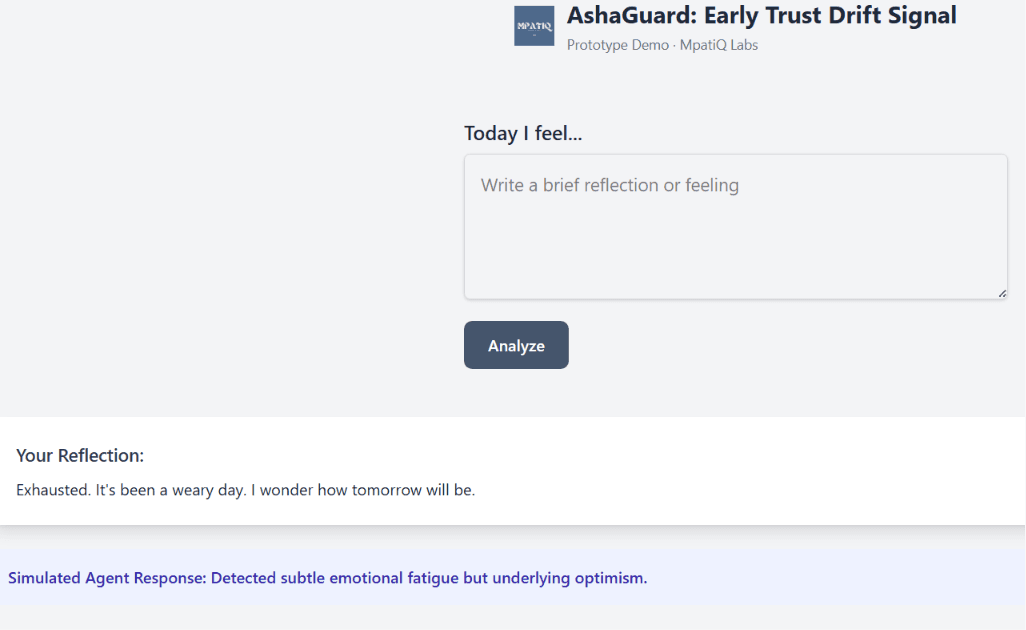
Capturing short personal reflections as structured inputs into future care-oriented interpretation systems.
Behavioral Signal Exploration
Exploring whether ordinary reflective writing could become an additional signal for observing gradual behavioral and trust drift.
Reflective Interaction Model
Prototyping the interaction between caregiver and patient reflections and future AI-assisted interpretation before implementing an intelligence layer.
Caregiver Support Framing
Building AI as a supportive observational layer that augments caregiver awareness rather than replacing human judgment.
Trust-Sensitive Care Architecture
Exploring how reflective systems might preserve contextual observations that accumulate meaning across time.
Prototype Interaction Loop
Testing the complete flow from reflection, to interpretation, to insight as the foundational interaction model for future research and production.
Disciplines
Care Systems Design
Human-Centered Design
Research & Analysis
Interaction Design
AI Interaction Design
Behavioral Modeling
Frontend Development
Tooling
Foundation
JavaScript
React
Vite
Interface
Tailwind CSS
Deployment
Vercel